
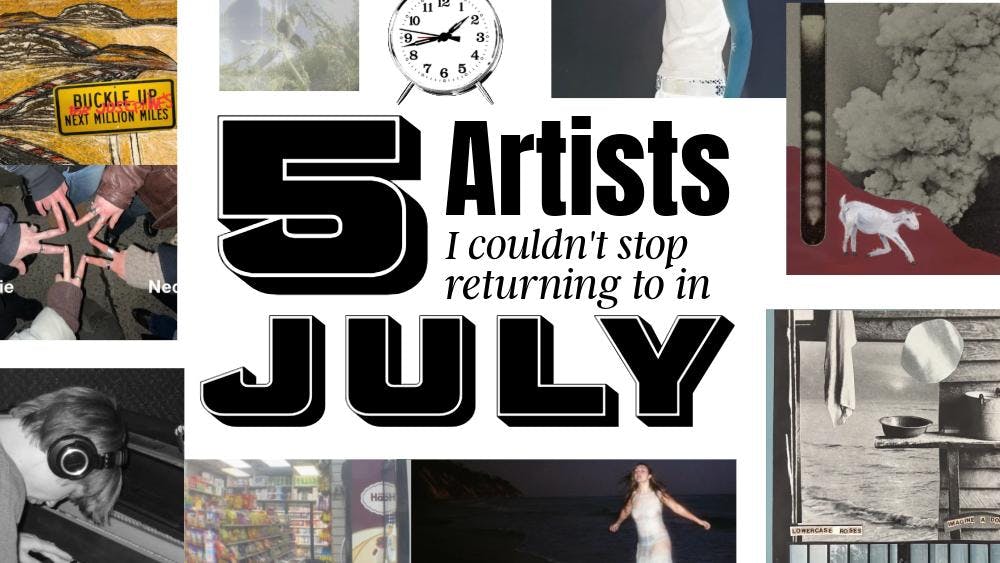
Throughout the week, our inbox fills with dozens of singles and albums from people we've never met.
Most arrive digitally with the same handful of words. For fans of... RIYL… A short, buffed out bio with a release date. Maybe a blurry press photo standing against a brick wall somewhere in Brooklyn, Austin, or Los Angeles with a wide list of tour dates below. By the next week, another hundred will have replaced them. Algorithms call this abundance when they can spoon-feed “curated” music to listeners whereas college radio calls these press releases homework.
The strange thing about discovery is that it isn't always the loudest chorus or the cleanest mix. For all the conversation surrounding streaming, recommendation engines, and editorial playlists that seem to know us better than we know ourselves, I still don't think technology has figured out the most important part of finding music: curiosity. Every artist below arrived through a friend or a recommendation from another band.
The records that stood out to me this month that you’ll see below weren’t a shared sound (I am not that good). If anything, these records reject the idea that independent music should have one. Instead, they leave imperfections where another producer might sand them smoothly and blend in with the noise, which is why I feel they’re worth talking about.
Croaker
The easiest mistake to make with "Easy" is assuming it's uncomplicated.
On first listen, the newest single from Brooklyn artist Croaker glides by on jangling guitars and the kind of melody that I feel like I’ve heard on at least a dozen U2 or Oasis songs my dad played me. It feels familiar in the way the best guitar music often does, borrowing enough from decades of indie rock like Interpol or Fontaines D.C. to sound lived in and familiar rather than relying solely on nostalgia (cough Lemon Twigs cough). Under that constant momentum with the driving bridges, the song keeps resisting itself lyrically, building a climax in the back half.
When I asked Tom McGahern, the nearly one man show behind Croaker on whether that push and pull was intentional, his answer suggested it wasn't something he designed so much as something he recognized after writing the song.
"The song itself was written really quickly... a lot of it was pretty instinctual. The melody and chords made me feel good, and on a certain level I just wanted to keep that feeling intact with the lyrics. But strangely, I think if the music is happy, the lyrics need some level of longing or struggle, otherwise it just ends up feeling empty."
That sentence explains something larger about his project compared to "Easy." It explains why so much contemporary indie music has drifted away from irony. For years there was pressure to disguise sincerity beneath an aesthetic distance, which I recently talked about around the new Chanel Beads record. Croaker does the opposite where the vulnerability exists alongside the melody.
McGahern says his writing process has become increasingly subtractive. Instead of asking what else a song needs, he started asking what can disappear.
"The longer I've been writing songs, the more I try to remove elements rather than add them. If a song is really good, you want to do your best not to distract from what's essential about it. Melody has become the north star."
It's a philosophy that's becoming surprisingly common among younger independent artists. Not minimalism for its own sake, but restraint. Confidence isn't measured by how much can fit inside a mix anymore, it's more so measured by what's allowed to remain exposed – see Dijon’s Absolutely or Mark William Lewis’ self-titled record.
That idea surfaces again when McGahern talks about the moment in "Easy" he's proudest of in his voice.
"I'm proud of singing with my full voice in a way I haven't in previous work. I'm dropping any pretension of trying to be a certain way. I'm letting it be poppy... maybe even a little corny. I don't feel as much pressure to appeal to a certain scene anymore."
There's something refreshing about hearing an artist describe confidence not as becoming louder but becoming less performative. "Easy" feels like someone finally giving themselves permission to stop pretending he couldn’t write a great pop song, not a reinvention of his sound.
Before we wrapped up, I asked McGahern (like every artist on this list) what he'd been listening to. "Necktie" by Chiara Savasta… She's going to be huge. Remember I said this."
Check out “Easy” and Croaker’s newest single, “Sonia Said” at the links below
Nico Valeriote
The singer-songwriter’s singles are out, and his EP is on the way.
Singer-songwriters aren’t back in the polished, confessional way that dominated traditional indie and folk music a decade ago, but in stranger way. There's been a growing appetite for records that feel unfinished in the best possible sense. Piano pedals creak, voices break, and songs end without solving themselves (Tom Waits would’ve loved to be debuting music now). Last year's wave of intimate releases, particularly Cameron Winter's Heavy Metal, reminded listeners that vulnerability doesn't need to be polished to feel profound, where sometimes the imperfections are the point in this anti-AI, quantization dominant music market.
Nico Valeriote's debut solo work belongs comfortably in that conversation, even if it arrives there by a different road in this post singer-songwriter era. Unlike the restless experimentation of his other projects, his upcoming EP’s tracks feel almost suspiciously close to the source. Piano and writing with little else standing between thought and listener.
When I asked what had shaped the music most over the past few months, he mentioned his life in lieu of another record.
"I went through the end of a long-term relationship before writing these songs. I wasn't waking up trying to make a project. I was genuinely trying to understand the feelings I was having through my piano and singing."
There's a temptation to idealize heartbreak as artistic drive. Valeriote resists that. His answer doesn't celebrate suffering. It simply acknowledges songwriting as a way of thinking. The songs became the place where he figured out what had happened, instead of simply documenting their history.
That same openness extended into the recording process, with one of the most unique recording setups I’ve heard of, as many of the record's defining moments appeared more or less by accident.
"We put room mics up and I paced around screaming lyrics for like fifteen minutes. That ended up making it into one of the songs. So many ideas came last minute because we were on the clock. We couldn't overthink them."
It's difficult not to hear that as a quiet rejection of perfectionism. Independent music has always celebrated DIY recording, but lately there's been a noticeable shift away from treating lo-fi aesthetics as an identity since they’ve oversaturated the market this decade. Artists like Nico seem less interested in sounding homemade than in preserving the feeling that existed before uneasiness in sonics arrived.
The songs he's writing now suggest another shift.
"The new solo songs are a lot less cynical. They have a lot more hope in them."
It's a remarkably simple definition of what’s to come… and maybe that’s the point. Some records announce a new era with reinvention. Others do it almost accidentally, by allowing a little more light into the room.
Before ending our conversation, when I asked what he was excited about, Valeriote pointed me toward classmate of his bandmates Avie Graves, whose song "Those Who Wait" has stayed in heavy rotation. Nico’s has two singles’ out for his new EP out in August, with my favorite linked below.
mer marcum
You Never Did Anything Wrong is the new EP from Mer that feels authentic and inspired.
Marcum's songs seem to arrive the same way memories do, unexpectedly, attached to strange details that somehow become the emotional center and authenticity of the songs. Listening to the EP, it's easy to imagine the songs appearing as jams capturing this emotional and raw sound quickly, which is almost exactly what happened. When I asked what someone would notice standing out in one of Marcum's recording sessions, the answer wasn't recording technique like Nico’s above. It was more about spontaneity.
"Pretty much nothing is premeditated. I'll see a phrase on a piece of sheet music on the piano and it'll become the concept of a whole song."
There's an easy write off there to call that writing effortless, but I feel it’s more accurate to call it attentive. Marcum writes as though the hardest part isn't inventing ideas but recognizing them when they arrive. That instinct shaped one of the EP's strongest moments in one of the tracks.
"'what is it about me?' took about an hour. I made it in my room in the middle of the night because it's the only time I can record without being interrupted by street noise. Once I made it, I didn't change anything except having my friend Noah add some bass."
So much of contemporary music celebrates revision. Like others on this list, Marcum seems more interested in preserving the emotional temperature of a first draft before it has time to settle, and even the smallest production decisions follow that same curiosity.
"The beginning of the title track was made with petittube.com." (a french site used to cycle through unwatched youtube videos)
It felt almost too casual to mention, which is probably why it worked. The internet becomes another instrument, another place where accidents become songs.
The next chapter for Mer is about becoming cohesive and lighter.
"Something a little less self-indulgent and a little more focused and playful."
That answer lingers because it quietly rejects the idea that complexity automatically makes art more meaningful. Maybe joy requires just as much craft.
Our interview concluded with Marcum recommending Josephine's Next Million Miles, calling it one of the best shows she'd seen all year.
Her new EP can be found below:
Lowercase Roses
Lowercase Roses is Matt Scheurmann’s project that seems focused on asking whether explanation is even necessary in explaining himself as an artist.
The Philadelphia songwriter occupies a scene that has quietly become one of independent music's thriving indie communities, where collaboration in sharing a bill matters more than competition and records are allowed to breathe instead of demanding immediate, quick attention. I was excited listening to the band's latest live release, but what stands out isn't technical perfection, it's live presence. You can hear people responding to one another in real time, songs changing shape and highlighting the human nature and input on them.
When I asked how he decides what to leave unresolved in his writing, the answer was centered around trust.
"Ultimately, I'm of the mind that everything is up for interpretation... I trust the audience to receive the music in whatever way is significant to them. It's all a subjective experience, and I think trust and a sense of letting go are inherent in the process."
It's an increasingly uncommon perspective that I found really unique. Music criticism often searches for definitive meanings, but Lowercase Roses seems content letting songs remain unfinished conversations. The listener becomes another collaborator in giving each song meaning rather than someone waiting for answers.
That philosophy carried into the band's new live album Imagine a Dog that excited me when I saw clips from it.
"I just love the sense of being together. It sounds like us when we practice or play live. We did a lot of touching up production-wise, but I'm really happy that we took the time to document what we sound like right now."
There's something admirable about releasing a document instead of a statement. In an era where every new record is expected to reinvent an artist, Lowercase Roses paused long enough to preserve who and what the band already was.
Looking ahead for his project, there are plans for another studio record, but even those ambitions seem rooted in curiosity instead of certainty.
"I've got lots of ideas for songs... I think we'll stumble upon some risks. I always love the process of adding and taking away, pushing and pulling. Music can be anything. I think it's easy to forget that."
That might be the simplest mission statement in this entire article that speaks for itself. Music can be anything.
Before closing out, Matt pointed me toward fellow Philadelphia band Doll Spirit Vessel, calling the city's scene "unrivaled" and wondering why more people aren't talking about them already, which I agree – the Philly scene produced my favorite record of 2023 in Golden Apple’s bananasugarfire.
Daisi
Every generation eventually decides genre is optional. For Daisi, drum and bass rhythms dissolve into dream-pop vocals. Alternative R&B textures coexist with indie songwriting. Indie or hyperpop are all treated as another color on the palette.
When I asked what had been shaping her listening lately, the answer jumped freely between scenes.
"Definitely Fcukers, Ninajirachi, Sweet Trip and Junior Mesa (I’m also a big fan). I've been really into DnB, hyperpop and blending different genres together with softer tones of my voice. It's fun to play around with and add contrast."
That word, contrast, ends up explaining her sound to a tee.
On her newest single that stuck out to me, “Luvbomb,” even microphone placement becomes part of the creative story.
"I sat far away from the mic and screamed the first line, then came in close with no pop filter for the rest of the song. It gives it kind of an Edward Sharpe feeling and makes the listener feel like they're in the room."
Most singers think about vocals as the center of a mix, whereas Daisi talks about them almost like brushstrokes, where someone like Mk.gee or James Ellis Ford would agree wholeheartedly.
"I like working with the production rather than having the production built around a song. The vocals act more like a paintbrush on top of everything else."
It's a subtle, but an important distinction as composition itself, and the next project from Daisi will push even further.
"More dancey, electronic music. It's gonna be a little jump from my last singles... but it all relates."
All I felt off that statement was excitement.
Before we wrapped up, she recommended artist J.Y.N., describing him simply as "an amazing songwriter and producer."
Daisi’s single that I was a fan of is linked below.
Five completely different records, EPs, and singles excited me this past month.
And yet I kept circling back to the same thought while looking back on this wide variety of genres. None of these artists were talking about growth in the language we're used to hearing. No one mentioned algorithms or content metrics, viewer retention, or finding "their brand." Instead, each interview eventually came around instinct by one way or another, whether that’s changing the acoustics or recording in the middle of the night. Maybe independent music has entered a quieter era in intention.
For a long time, being independent often meant trying to sound unlike everyone else. Now it feels more like trying to sound unmistakably like yourself. It's also why radio, and especially college radio, still matter. The job has never been predicting who becomes famous. It's paying attention before assurance comes. It's believing that somewhere inside an inbox full of strangers, one song might stay with you long enough to change the way you listen or think. This month, no matter how different they all sound, these five records did.
On Repeat for each artist:
Croaker:
Nico Valeriote:
Mer Marcum:
Lowercase Roses:
Daisi:
