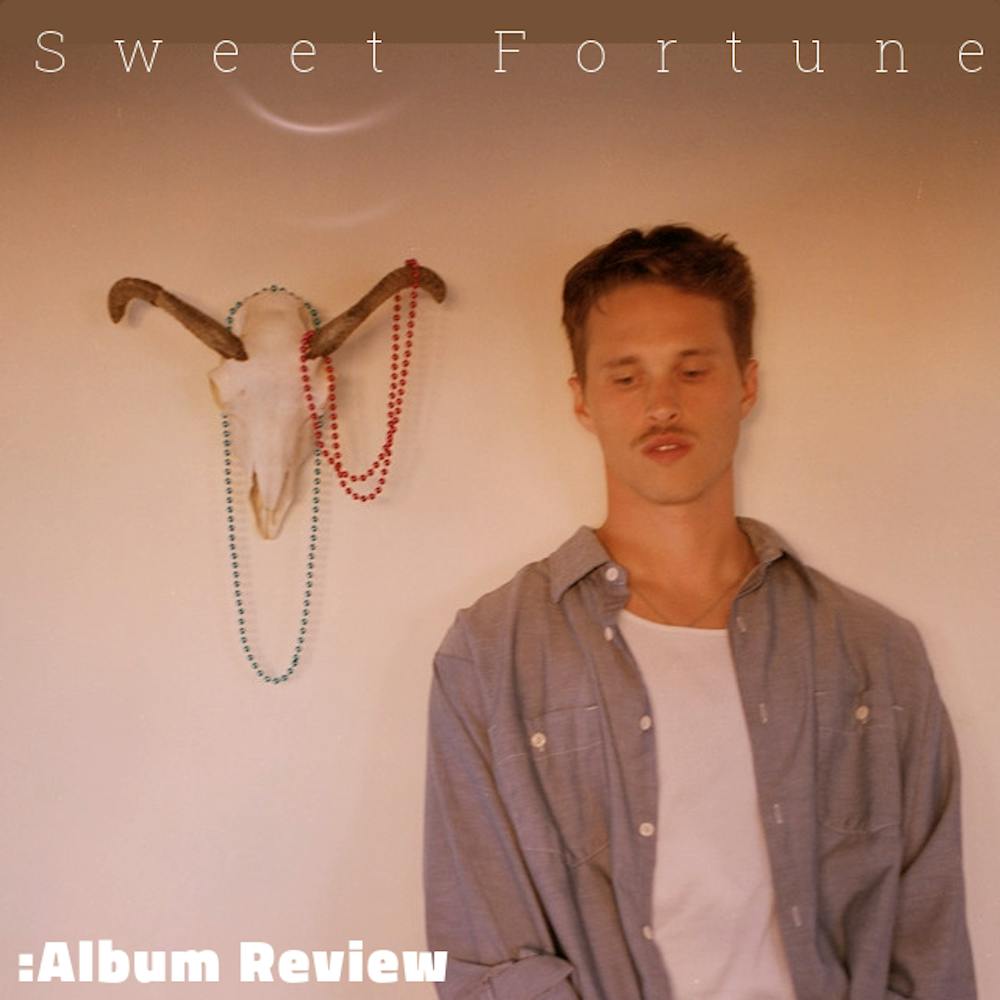
I’ve been completely spun out listening to the new Chanel Beads record this past week, but I while I was writing about that album, I kept seeing people call Sweet Fortune Ryan Beatty’s "happiest" album on the subreddit popheads. On first listen, I get it. It’s definitely lighter than Beatty’s previous album Calico. The music breathes a bit more, his voice feels less strained, and he isn't pulling you down into the same emotional pits that defined his last album. Beatty himself has described this period as one written from happiness rather than heartbreak, though even he has said that shift came with a strange kind of anxiety. Joy, he said, didn’t feel like relief so much as exposure. There’s less distance available between feeling something and having to say it out loud.
What that does to the songs becomes clearer the longer you sit with them.
Calico felt like an attempt to unpack the past. Sweet Fortune is different as it's locked into the present. The tracks don't longingly linger like ghosts the way his old stuff did. They move forward. Beatty seems less interested in explaining how he feels and more interested in just sitting with the feeling as long as possible. The opener, “Phantom,” arrives before any of that settles with driving piano. Beatty described it as something written while he was still finishing the Calico tour, a track that belongs to the spirit of both records without fully committing to either. That overlap matters, making it sound more like someone still half inside the emotional display of Calico while beginning to notice something else taking shape underneath it. The song carries the weight of performance, of standing in front of something larger than yourself, but there’s already a loosening in how that feeling is held.
You can still hear him wrestling with that on the next few tracks:
Take "Secret Language," which pops up early on the track list and quietly sets the tone for the rest of the album if you didn’t hear it as a single. There are lines in the first verse and hook where he questions if his words were actually heard, if they did any good, or if he just didn't say them right. These lyrics don’t feel like a heavy-handed, crushing thesis, but that specific anxiety keeps bubbling back up to the surface. Beatty has said in an interview with Variety that the music itself often carries more of the emotional narrative than the lyrics alone, and that idea becomes easier to hear as the record unfolds. Meaning doesn’t sit only in what is said. It cultivates the environment and atmosphere around it. That’s especially true in the way Ryan writes about distance. Geography runs through these songs in a way that never quite settles into metaphors. Places aren’t just setting, and they aren’t quite symbols either. They function more like strong emotional signs that keep shifting depending on who is speaking and who is being spoken to. Massachusetts appears as a fixed point in one anecdote, New York in another and California seemingly as a home behind everything else. These aren’t abstract references. They feel like lived conditions and tales, pulled from movement instead of imagination.
“Too Many Ways” captures that in passing.
A relationship exists inside the mention of a place rather than in any direct declaration. The distance is stated without explanation, as if explanation would only weaken it. The effect is that love doesn’t arrive as a statement in these songs so much as something embedded inside ordinary details. That logic repeats in different forms across the record, but it becomes more noticeable when the writing hones in on contrast rather than description. “Dust” holds two feelings in the same breath without trying to reconcile them. “I love New York / I hate New York.” Nothing in the delivery asks for resolution. The contradiction is left intact, and the song continues moving anyway. That willingness to let opposing emotions exist side by side runs through much of Sweet Fortune. It rarely feels interested in settling emotional tension. It tends to keep it in motion instead.
The production reflects that limit.
Exec producer Ethan Gruska, who’s been behind some great albums with creatives like Phoebe Bridgers and Bon Iver, builds these songs with a cinematic softness that never pushes itself into the foreground ever so slowly. Acoustic instruments led by tight percussion, brass, and strings that appear and recede without typical composition. Beatty has described wanting the music to feel emotionally connected rather than simply larger, and that decision shapes how every arrangement behaves. Nothing tries to dominate the frame. Even the most expansive moments feel like they are unfolding rather than arriving. What ends up standing out is not volume or scale, but how consistently the record avoids forcing meaning into place. It allows phrases to sit where they are written, allows silence to remain part of the sentence, and allows location, repetition, and small changes in tone to carry more weight than vocal inflections or emphasis ever could in these settings. By the time the album reaches its final stretch, something subtle has shifted in how closeness is being described. Not resolved, not explained, just approached differently. It feels like once you pass “Annie, Anything,” Delancey begins to feel less like a street name and more like a point the entire record keeps turning back toward without ever closing the chapter on what it means to Ryan.
Coming back to Sweet Fortune for another listen, something started to repeat itself without me really noticing at first.
I wasn’t going back to more easier listens like the single “Secret Language” or “White Lightning,” it kept being “Annie, Anything.” It isn’t really positioned as the emotional peak of the record. Nothing about it signals that it should be the song that lingers after every other verse. But by the time the album ended, I kept circling back to it as the writing struck me differently with the falsetto delivery. At some point, I stopped trying to figure out why it stuck and started paying attention to what the track was doing differently from the songs before.
“For miles and miles I'd drive, just to keep my mind off you,” “I've counted a thousand moons,” and “I'd give anything to get to you” stuck out to me.
The writing doesn’t stretch itself into metaphor or complication. Compared to Calico, where almost every image feels like it opens onto another memory or another layer of meaning up to interpretation, this feels almost exposed in how direct it is. There’s less distance between thought and language here. The song doesn’t circle its feelings before naming them. It just stays direct and close to them. The americana sound and almost reverent, bright organs stuck out to me as the production highlight with the saxophone solo as well.
That shift feels more noticeable on a record that so often leans on indirect expression.
So much of Sweet Fortune builds meaning through everything surrounding the words rather than the words themselves. Geography carries weight. Arrangements extend emotion beyond the lyric. Even silence becomes part of how a line lands. “Annie, Anything” doesn’t discard that approach, but it moves past the need for it. By the time Beatty returns again to “I'd give anything to get to you,” it already feels understood, not because it’s been explained, but because the record has already trained you to hear it without needing reinforcement, especially with his vocal style. The driving imagery takes on a different shape here. Across Sweet Fortune, roads tend to separate people. Cities hold distance inside them. Massachusetts, New York, California, Delancey Street, each one marking a gap that needs to be crossed. In “Annie, Anything,” movement stops feeling like separation and starts feeling like decision. The miles are still there, but they register as resistance already accepted.
Thinking back about the track list through that mindset, “Phantom” starts to shift in meaning immediately.
“I’m dulled, I’m dancing in the cold,” “I bend, but I don't fold,” and “It’s love, held with lonely hands” struck me differently this time around.
The language there still carries a kind of performance to it. The stage, the audience, the final bow, all of it frames emotion as something happening under observation. Even love is filtered through endurance and presentation. Beatty has described “Phantom” as both a farewell and a beginning and listening with the rest of the album in mind, it feels less like a transition between projects and more like a moment where that need for performance is still present, before it quietly dissolves over the course of the record.
By the time “Fleur De Lis” hits the listener, there isn’t much left of that framing.
Nothing about it feels like it’s being delivered outward. It just sounds like someone speaking directly to another person. Beatty has said in interviews around this new album that writing from happiness felt more exposed than writing from heartbreak, because there was less to hide behind. That idea lingers over the entire record. What vulnerability looks like here isn’t tied to confession or intensity. It comes from how little the songs rely on disguise. The writing doesn’t avoid feeling, but it also doesn’t protect it with distance.
By this point in the record, the question feels like it’s changed to, how long can you stay close to love when it’s present without stepping back from it for your own good?
Calico spent its time trying to understand what was already gone. Sweet Fortune stays with what is still here, without reaching for distance to make sense of it. And somewhere in that shift, “Annie, Anything” keeps returning to me, not because it stands apart from the rest of the album, but because it doesn’t. By the time Sweet Fortune fades, it doesn’t really feel like it’s trying to resolve anything in the way albums once were expected to. It lingers more as a set of movements through intimacy, each one shaped less by climax than by accumulation. That shape feels increasingly familiar across a wider stretch of indie music right now, where emotional clarity is often less about arrival or climax and more about proximity, like I saw with the Chanel Beads album that came out the same day.
A lot of that modern indie seems to be built on that logic of staying close while fully leaving the idea of closeness open to interpretation:
It fits perfectly into what a lot of indie music is doing right now in prioritizing sonics and raw atmosphere over polished, textbook songwriting and riffs. Music critics love talking about "restraint" right now, but there's a reason for it. Look at artists like mer marcum or Tobias Jesso Jr. There's a massive shift toward songs that feel slightly unfinished, raw, and atmospheric rather than perfectly polished. Beatty fits right into this wave. He isn't trying to solve an emotional puzzle for the listener, he's just letting you walk through it with him. In this, it feels like the front to back album rising from the dead, which is a topic for another day. Even the most structured songs often behave like rural, intimate scenes from a musical rather than emotional statements, unfolding gradually instead of resolving cleanly. Part of what makes that approach resonate is how often it refuses certainty or quantity, which you see success in that with the rawness artists like Dijon or Jia* today. There is a growing comfort in songs that leave meaning slightly unfinished and sound raw, where a lyric doesn’t lock itself into interpretation because it doesn’t need to. In that sense, Beatty’s writing fits into a wider shift rather than standing apart from it. The distance he keeps returning to in Sweet Fortune, whether through cities, repetition, or arrangement, doesn’t feel like abstraction for its own sake. It feels closer to how a lot of modern indie treats emotion now, as something you move through rather than something you solve.
That’s where Delancey begins to matter more than it initially suggests.
By the time the record starts circling it, the name doesn’t really behave like a reference point anymore. It reads more like a place the album keeps approaching without fully settling into. Not a symbol in the usual sense or another city in rotation in Beatty’s life, but something that sits at the tip of the tongue. The closer Sweet Fortune gets to “Delancey,” the less it feels like it’s rooted in places, and the more it feels like the idea of landing somewhere without needing to translate what arrival feels like. And even after everything resolves, “Delancey” doesn’t land like a destination. It hangs back as something the album keeps drifting toward, especially in the moments where meaning starts to thin out and only feeling is left carrying the weight.