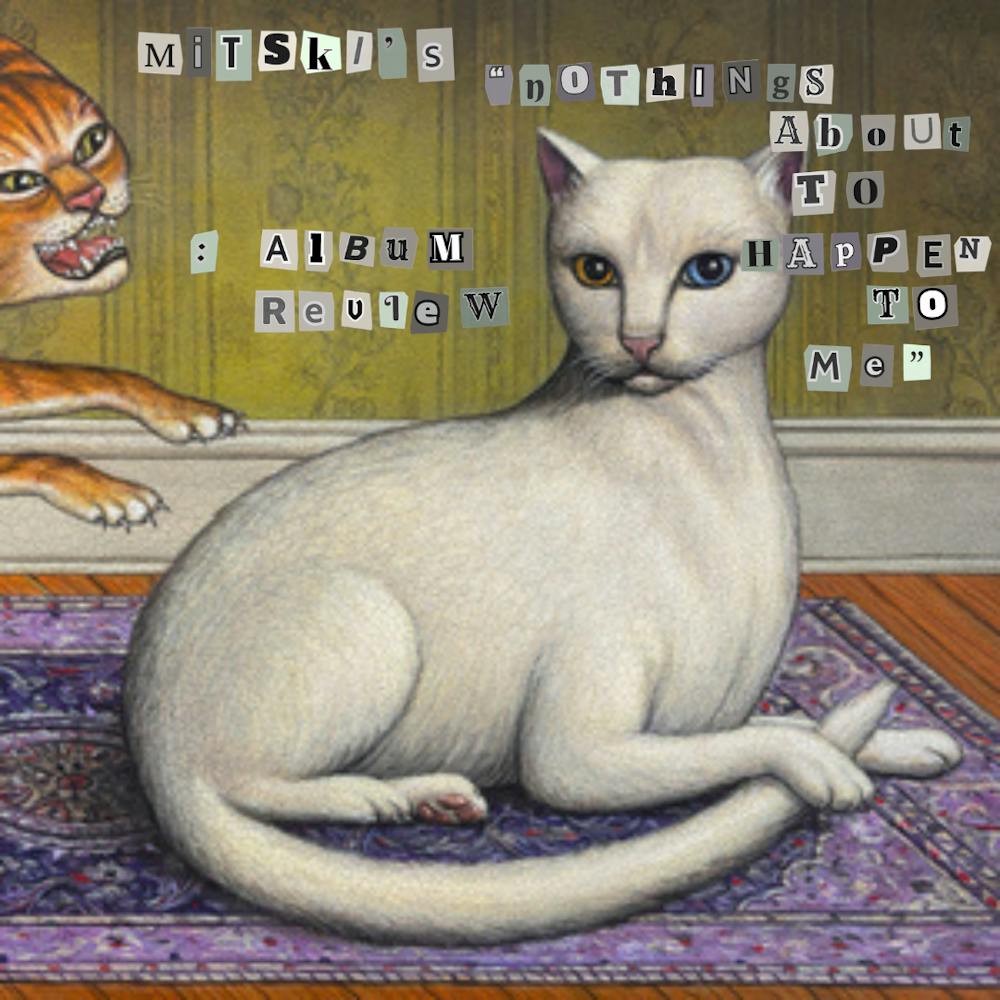
Mitski's most recent album, released on Feb. 27, 2026, “Nothing’s About to Happen to Me” continues her unique, contemporary stylings and instrumentation she became famous for.
Since her breakout album “Burry Me at Makeout Creek” in 2014, Artist Mitsuki Laycock, better known as Mitski, has been bringing deep introspective music to a rapidly expanding fanbase. She started her music career at SUNY Purchase College's Conservatory of Music, where she released her first two albums, “Lush” and “Retired from Sad, New Career in Business.” Since then, she has released 6 more albums and as artist Lucy Dacus puts it, “Provides a space for those who want to scream about their sorrows."
The album opens with the track, “In a Lake." This song talks about the struggles of being perceived in a small community, and how it would be better to be isolated completely, or in a larger-than-life city to unapologetically be who you are. One standout line was, “I'm slow to learn all the rules. I've tried very hard to be good. But when they think you're bad, people act worse.” This line feels very similar to the experience of going to a new place and trying to change your ways to fit in with this new group. The starting instrumentation is reminiscent of the opening songs off her last album using calm acoustic guitar. Despite her repetition of similar instrumentation, she has no trouble making each album it’s own unique product. She backs up the guitar with an accordion which really adds a sense of tension to the track. In a move that Mitski typically does in her songs, and to clarify this is one of my favorite parts of her music, the end brings an almost chaotic mix of instruments to lead the song to it’s climax.
Next on the album is the first single released in its promotion, “Where’s My Phone?” This track tells a story about helplessness in today’s society. In the song she desperately looks for her phone, while also saying she wishes her mind was empty like a clear glass. This reads like she needs the distraction from everyday life, but wishes her mind was empty of what she needed to be distracted from. Later in the song she sings, “If night is like you punched a hole into tomorrow, I would **** the hole all night long." This is a direct quote, symbolizing that the swearing was censored by some power other than herself, this is evident by her swearing without censorship in other songs on this album and others. Alongside the nonsensical bridge and distortion on her vocals in the end, it brings to mind the silencing of one’s voice and autonomy.
Next up is the track, “If I leave." This song continues the narrative of the last song, talking about what would happen if she took the risk and left the person she loved. Along with this, she talks about her fear of not having relief from the hard experiences in her life, mentioning how alone she feels . “How I ride through a tunnel And it's dark the whole way” In the middle of the song there is a shift from the instrumentation similar to the previous song, to a more heavy rock instrumentation reminiscent of her song “Francis Forever."This choice makes the song connect more emotionally, with the intense backing matching the fear of being in that kind of situation.
After that is the track “Dead Women.” This song talks further on her fear of loss of autonomy. She sings about how her legacy could be altered after being killed by someone else’s hand. “While I dream of flying, stab me twenty-seven times . . . Then embalm me up 'cause you're hosting the viewing. Saying, 'She gave her life so we could have her in our dreams,' 'She gave her life so we could f**k her as we please'.” The title shows that the song is less of a personal story, and more of a universal tale that can be applied to the experience of women as a collective. Lamenting the too common societal practice of women’s stories being altered by means outside of their control. The instrumentation of the song is a standout on the album, with the main chords outlined with a breathy organ throughout, and the climax backed up with soaring strings, and an almost out of tune percussion element similar to a glockenspiel giving the end a sense of fear.
The next song “Instead of Here” depicts her experiences with depression from a young age. The line “Where nobody can reach” is repeated many times throughout the song, illustrating both her withdrawal from the outside world, and her brush with death in a possible suicide attempt. She says that death told her “She wished I knew that I was still a kid, but knew she would see me again.” After this encounter she grapples with her depression, pleading to the stars, “Is this what it’s worth” only to get no reply. In the end she returns to wallowing in her own sadness, going where nobody can reach. The songs instrumentation brings forth a feeling of comfort, showing her contentedness with her sadness. To match with her feelings of hopelessness, the backing stays relatively the same through the track, showing her fear to, or unwillingness to try and help herself.
As the second single to come from the albums pre-release, “I’ll Change for You” continues the narrative from “Cats” and “I’ll Leave.” In a turn from the first song, she is desperate to get back with the person she loved. After the separation she falls into a cycle of drinking, saying “Bars, such magic places. You can be with other people, without having anyone at all.” She follows this by saying she’d change her ways for the one she loves. The track is a welcome change from the others, going for a bossa nova inspired backing, with more intricate guitar work, piano riffing, and flute inclusion.
The next track “Rules” is the most surprising song on first listen. It starts just with her counting from one to five in repeated patterns. It’s then revealed that the counting is a recollection of the stages she feels she goes through in every relationship. The steps involve her being pushed deeper into her self destructive habits to try and appease her lover, only to leave to get a sense of relief from the pain. In the end she continues counting up to 11, possibly showing an end to her cycle, and finding a way to healthily move on with her life. The instrumentation in this song is one of my favorites on the album, including regal fanfare from the brass, jazzy electronic piano and bass clarinet solo elements.
Following this is the darker sounding track, “That White Cat.” This track follows the feeling of helplessness depicted in in previous songs. She tries to get help from her mother, but all she says back is, “Things will leave you. They get broken, they get lost. The only thing you can trust is what you lived through." This idea of being a victim to the cycle of the world is further demonstrated when she goes through the circle of life later in the song, that benefits everyone but herself. The driving drum beat in the track mirrors the cyclical messages in the song. The tone of the guitar adds to the intense feel of the song, opting for a twangy electric guitar as opposed to the typical acoustic seen on the album. Her vocal style in this track gives a great example of the range she can show from loud and intense to calm and wispy.
Next up is “Charon’s Obol” This title is in reference to the coin placed in the mouths of the dead, used as payment for the ferryman between the worlds of the dead and the living. This song further continues the idea of societal pressure and reputation, this time for an old house in which the previous owners died. While the rest of society shuns the house, our singer takes residence in it, caring for the dogs left by the past owners, and working to serve as the girls own “Charon’s Obol.”
Ending off the album is the track “Lightning.” Bringing the subject of mortality to a close, this song talks about Mitski’s ideas on life after death. She seems to finally be content with her own death, eagerly awaiting what happens next, no matter the outcome. “If I'm dark, all the better to reflect the moonlight. If I mourn, all the better to behold the sunrise.” The concept of death is a focus of the album, with the title “Nothing’s about to Happen to Me” illuding to death, as the “nothing” it mentions could be the lack of life. Even the two album covers follow this, one showing a zoomed in cat, and the other showing the full picture of a the tiger attacking it, all while the cat is unaware.
While not re-inventing the wheel, “Nothing’s About to Happen to Me” is yet another impressive addition to Mitski’s discography. Musically, the album feels like a culmination of all the different instrumental styles she’s used in her past works. Going from the effects of depression to the desire to not exist, the album paints a beautifully tragic picture of the struggles of modern life. She’ll be giving listeners an inside look at the so-called “Tansy House” on tour from March 3rd to July 26th.